


A short analysis of the Klon Centaur, its associated myths and its alternatives
shopping_cart
0
Latest posts
-
 Why does the Klon work ?Read more
 -
 Why does the Tube Screamer sound bad ?Read more
The mythical Ibanez Tube Screamer is not free of issues ! Let's talk about why I dislike its sound so much.
-
 Master fuzz clean-up like a pro !Read more
Let's talk about volume clean-up, vintage fuzzes and buffer pedals, and how everything interacts together.
-
 Circuit Analysis : Electro Harmonix LPB1Read more
Let's dive deep into electronics and explore the Electro Harmonix LPB1 and Screaming bird at once !
-
 Master the art of reampingRead more
Let's talk about how to use a DI box and a reamp box and what they are doing under the hood.
-
 How to record an electric guitar : all about microphonesRead more
All you ever wanted to know about recording your electric guitar amplifier with microphones, but were afraid to ask !
-
 Guitar preamps: are they a scam?Read more
Understand what really is a guitar preamp pedal, its difference with a studio preamp and an overdrive pedal, and how...
-
 The art of stacking effects pedalsRead more
Discover how to master pedal stacking with overdrives, saturations, compressors, and time-based effects. Learn the...
-
 The ultimate power supply guideRead more
Let's explore what make a good power supply, how to choose one and how to read their labels to prevent frying up your...
-
 Flanger is the BEST modulation pedalRead more
Hot take : flanger is definitely the best modulation effect ever invented. I can have it replace a phaser, a chorus...
Blog categories
Search in blog
Why does the Tube Screamer sound bad ?
The Tube Screamer is undoubtedly the most famous and widely used overdrive pedal in the world, and perhaps the most recognizable effects pedal of any kind. With its iconic green enclosure and white lettering, you've almost certainly heard of it, maybe even tried it, loved it... or not. If, like me, you dislike the Tube Screamer, or simply find that it doesn't sound good with your amps and guitars, stay with me for this article where I explain why the Tube Screamer isn't always the best option.
1. History lesson
In 1979, Susumu Tamura, an engineer at the Japanese company Nisshin, owner of the Maxon brand, was tasked with designing a pedal that the company would manufacture for Ibanez to compete with the legendary Boss OD-1 and the American MXR Distortion Plus. He took inspiration from the OD-1 while working around Boss's patent on asymmetric clipping, creating the first overdrive with symmetric clipping and, more importantly, a tone control that allowed players to adjust the amount of treble in the sound. The Tube Screamer was born, and it has remained in both the Ibanez and Maxon catalogs for decades, right up to today.
Since its release, hundreds of thousands of guitarists have used this pedal. Among the most famous are Kirk Hammett (Metallica), John Mayer (who plays a TS10), Jerry Cantrell, Stevie Ray Vaughan, and David Howell Evans, better known as "The Edge" (U2). And with such an impressive list of users, it was only a matter of time before the internet started dissecting this legendary pedal, tearing it apart and building countless myths and legends around it.
2. The circuit and its myths
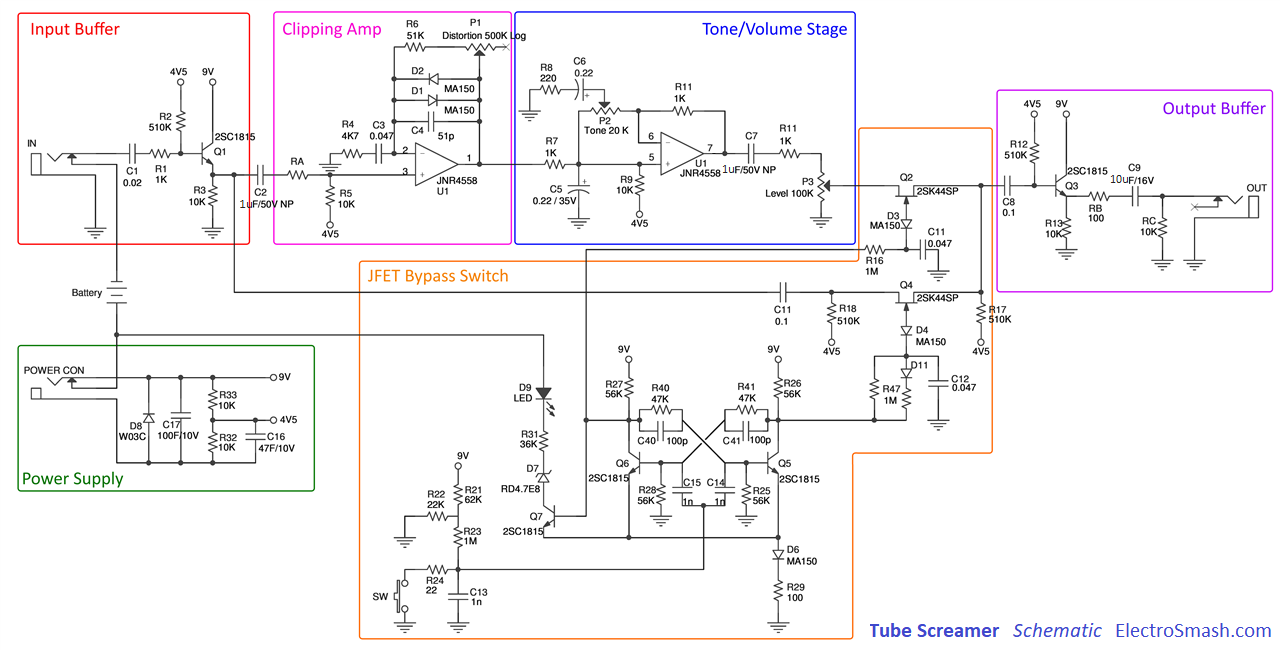
Here is the Tube Screamer schematic, originally taken from the now-defunct Electrosmash.com website. The entire orange section corresponds to the effect's on/off switching, which we won't discuss here. On the far left, you'll find a bipolar transistor input buffer used to match the pedal's input impedance to the guitar, followed by the clipping stage, which is simply a non-inverting operational amplifier. The distortion comes from the two MA150 diodes connected in opposite directions inside the feedback loop. Next comes the active tone-shaping stage, implemented as a shelving filter, followed by the volume potentiometer and finally an output buffer capable of driving long cable runs.
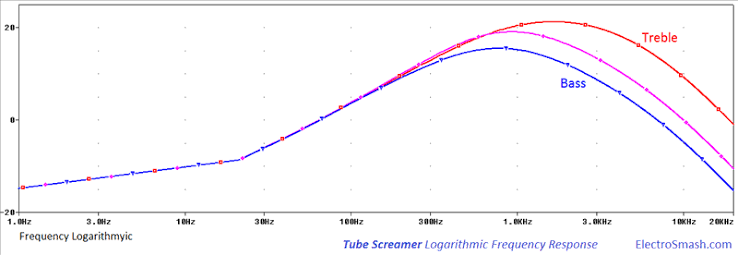
Probably the most interesting characteristic is the frequency response, shown here with the gain at maximum while moving the tone control between its minimum (bass), middle, and maximum (treble) positions. You can clearly see that the pedal heavily boosts the midrange, with a peak around 800 Hz extending up to roughly 2 kHz. It also cuts a significant amount of bass.
The circuit is actually quite clever and surprisingly complex, mainly because of its buffers and active filtering stage. Several versions followed the original TS808, including the TS9, whose circuit I've just described, the TS10, the plastic TS5 from the SoundTank series, and more recently the TS Mini and the hand-wired TS808HW.
Naturally, the internet loves arguing about which version sounds best. Here are some of the most common myths you'll find online.
"The TS808 sounds better than the TS9."
Maybe to your ears, but electrically, the only difference lies in the value of two resistors in the output buffer. In practice, they have absolutely no impact on the pedal's frequency response, dynamics, or clipping behavior. If there is any audible difference, it is extremely small and easily overshadowed by the normal component tolerances found in every pedal.
"The TS10 is the best Tube Screamer."
No. It's essentially the same circuit as the TS9, simply housed in a cheaper and less reliable enclosure. Whether you want to pay more for something that's mechanically less durable is up to you.
"The vintage JRC4558 op-amp is the best."
It is indeed the operational amplifier used in the very first Tube Screamers before Maxon switched to the Toshiba TA75558. JRC stands for Japan Radio Company, the semiconductor manufacturer. The 4558 is simply the op-amp model number, and it is still manufactured today by many different companies in a variety of packages. The actual internal design, however, has remained essentially unchanged since its creation. Once again, any differences are far smaller than the normal component tolerances from one pedal to another. As for the clipping itself, the diodes have a much greater influence than the op-amp, and the op-amp will never clip on its own unless you hit your Tube Screamer with an enormous boost.
"Running it at 18V provides more headroom than 9V."
Wrong again. As long as you aren't feeding the pedal with an unusually hot input signal, you won't hear any difference. The circuit itself clips the signal naturally at around 0.7 V, even with the gain turned all the way up. The signal never gets anywhere close to the power supply rails, so increasing the supply voltage has virtually no effect. Some pedals do benefit from 18 V operation by offering more headroom, but the Tube Screamer is simply not one of them.
3. Positive and negative aspects
If you like the Tube Screamer, it's probably for one of several reasons.
First, imitation plays a role. Almost every guitarist has used one at some point, so it's perfectly normal that you've tried one, maybe even adopted it. Your ears have probably become accustomed to its distinctive voice through the hundreds of artists who have used it.
Second, it's incredibly easy to dial in, with only three simple controls, and it's relatively affordable if you're willing to buy an entry-level clone.
If you happen to play through a Fender tube amp, the Tube Screamer also pairs particularly well with it. It was apparently developed using a Fender Deluxe Reverb, which explains why it works so well with these amplifiers and single-coil pickups.
Finally, thanks to its aggressive bass cut and pronounced mid boost, it helps your guitar cut through a mix or push an already overdriven amplifier harder, making it especially useful for heavier rock and metal.
That being said, I personally dislike the Tube Screamer's voicing for exactly the same reasons many people love it.
To begin with, the pedal isn't exactly cheap if you're after the TS808 reissue (as we've seen, the TS9 and TS Mini are more affordable alternatives). The mid boost is far too nasal for my taste, and if your goal is simply to boost an already overdriven amplifier, a good EQ or a more versatile overdrive does the job much better.
The Tube Screamer also has a fairly modest output level by modern standards. But its biggest weakness, in my opinion, is its severe lack of dynamics. It clips the guitar signal far too early, producing an odd texture somewhere between clean and overdrive that I simply don't enjoy.
4. Alternatives
Since the original pedal has always retained these inherent limitations, the boutique market quickly responded with countless variations, allowing every guitarist to find the Tube Screamer that best suits their taste.
That said, if you're looking for an overdrive with more personality at a similar price, take a look at the Boss BD-2. If you need more gain, the Fulltone OCD should make you happy. And if what frustrates you is the lack of dynamics, the Klon Centaur addresses that issue beautifully.
Finally, if you're looking for a pedal that is functionally equivalent to the Tube Screamer but significantly more versatile, I build the Singer Overdrive. It offers roughly the same amount of gain, but the way it generates that overdrive makes the playing feel much smoother and more responsive. It features a more refined midrange hump and, above all, a three-band active EQ that allows you to fine-tune every part of the frequency spectrum. You can boost the mids as much as you like or scoop them to achieve a sound much closer to a tube amplifier. The available output level is also substantially higher than that of the original Tube Screamer.
To sum up, the Tube Screamer remains the classic, hassle-free overdrive that virtually every guitarist has tried and heard. However, it also retains several shortcomings compared to more modern designs. There are countless clones and variants available, but very few truly address the original circuit's limitations without fundamentally moving away from what makes a Tube Screamer a Tube Screamer.
Designed from the ground up as a better alternative to the Tube Screamer, the Singer Overdrive, developed in collaboration with the boutique amplifier company AmS, offers far greater versatility and is an excellent choice for players looking for a great overdrive without the traditional Tube Screamer compromises.
Related posts
-
 Different flavours of overdrive
Overdrive definitely is the queen of saturation effects. There are so many ofthem though, how can you be sure to...Read more
Different flavours of overdrive
Overdrive definitely is the queen of saturation effects. There are so many ofthem though, how can you be sure to...Read more -
 The truth about transparent overdrive
In this article, I talk about the concept of transparent overdrive, and why this designation became a marketing...Read more
The truth about transparent overdrive
In this article, I talk about the concept of transparent overdrive, and why this designation became a marketing...Read more -
 Understanding saturation effects
Saturation effects are many : distortion, fuzz, overdrive, preamps... What should you look for on the market today ?Read more
Understanding saturation effects
Saturation effects are many : distortion, fuzz, overdrive, preamps... What should you look for on the market today ?Read more -
 The wonderful world of fuzz
Are you often left scratching your head when talking about fuzz ? Read our guides and understand the main differences...Read more
The wonderful world of fuzz
Are you often left scratching your head when talking about fuzz ? Read our guides and understand the main differences...Read more -
 The tone of the RAT
The ProCo RAT is one of the most known distorsion pedal. Learn about its tone and history here !Read more
The tone of the RAT
The ProCo RAT is one of the most known distorsion pedal. Learn about its tone and history here !Read more
Leave a comment