


The mythical Ibanez Tube Screamer is not free of issues ! Let's talk about why I dislike its sound so much.
shopping_cart
0
Latest posts
-
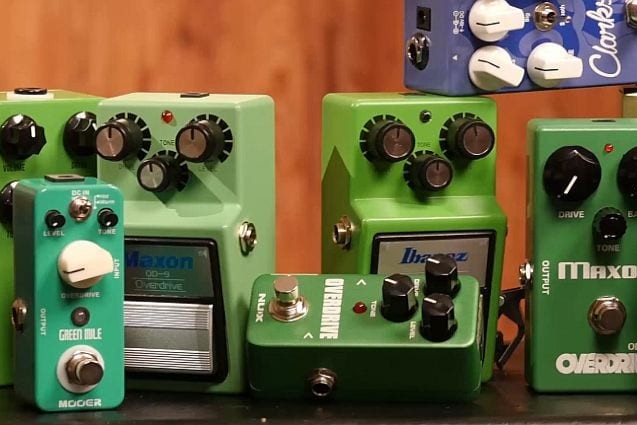 Why does the Tube Screamer sound bad ?Read more
 -
 Master fuzz clean-up like a pro !Read more
Let's talk about volume clean-up, vintage fuzzes and buffer pedals, and how everything interacts together.
-
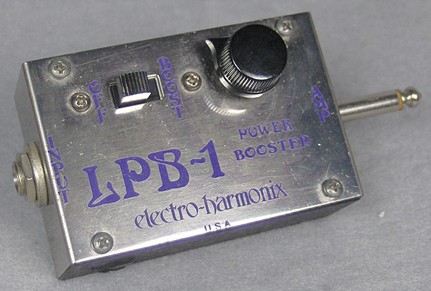 Circuit Analysis : Electro Harmonix LPB1Read more
Let's dive deep into electronics and explore the Electro Harmonix LPB1 and Screaming bird at once !
-
 Master the art of reampingRead more
Let's talk about how to use a DI box and a reamp box and what they are doing under the hood.
-
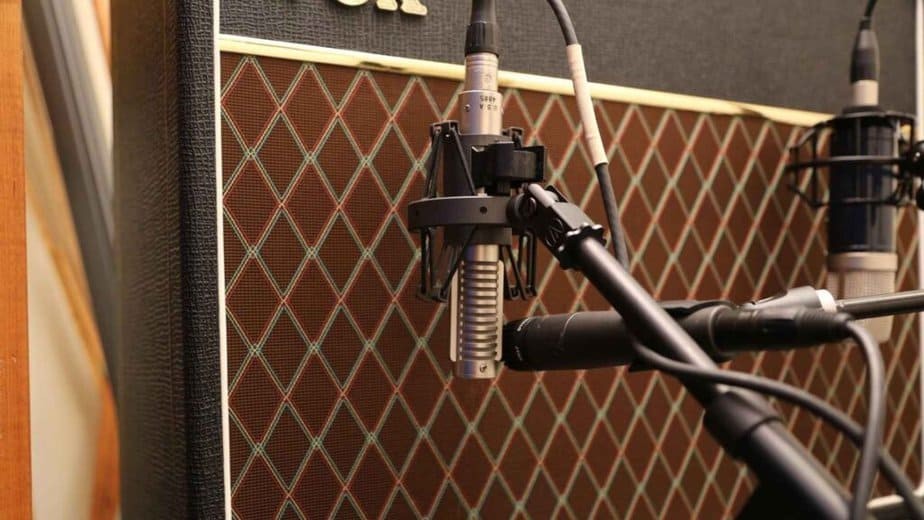 How to record an electric guitar : all about microphonesRead more
All you ever wanted to know about recording your electric guitar amplifier with microphones, but were afraid to ask !
-
 Guitar preamps: are they a scam?Read more
Understand what really is a guitar preamp pedal, its difference with a studio preamp and an overdrive pedal, and how...
-
 The art of stacking effects pedalsRead more
Discover how to master pedal stacking with overdrives, saturations, compressors, and time-based effects. Learn the...
-
 The ultimate power supply guideRead more
Let's explore what make a good power supply, how to choose one and how to read their labels to prevent frying up your...
-
 Flanger is the BEST modulation pedalRead more
Hot take : flanger is definitely the best modulation effect ever invented. I can have it replace a phaser, a chorus...
-
 The ultimate guide about modulation effectsRead more
Modulation effect pedals form a distinct category of guitar pedals. What are the differences between a chorus, a...
Blog categories
Search in blog
Master fuzz clean-up like a pro !
In almost every pedalboard, you’ll find the same rule: vintage fuzz pedals must be placed first in the signal chain. Before delays and reverbs, before overdrives, and especially before buffers. It has become a kind of universal truth among guitarists. But why do we do this? Is it simply a superstition inherited from the 1960s, or is there a precise electronic explanation behind the famous clean-up of the Fuzz Face and similar circuits?
In this article, I’d like to break the phenomenon down in simple terms to understand how the interaction between the guitar and the fuzz shapes the sound — and why placing a buffer before it can change everything.
1. Electrical resistance
Before anything else, it’s helpful to recall what an electrical resistance is. A resistor is a passive electronic component that opposes the flow of current. When current attempts to flow through a resistor, this opposition creates a voltage across its terminals. Conversely, applying a voltage across a resistor allows current to flow according to the well-known Ohm’s law: U = RxI.
To simplify, you can think of electrical resistance like a queue at an airport. If people arrive (voltage), they will pass through at a certain rate, one after another (current). The time it takes to pass through the line is analogous to electrical resistance.
When two resistors are placed in series, they form a voltage divider. This is equivalent to having two queues in a row: to get the same number of people through, you must add the time spent in each line. In electrical terms, the voltage splits across each resistor in proportion to its value relative to the total resistance:
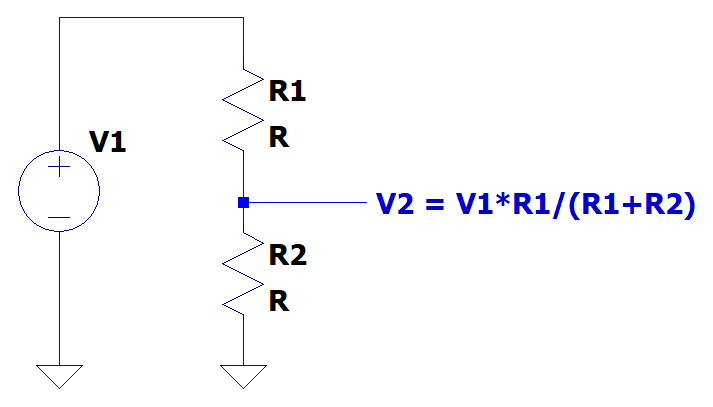
From the voltage divider formula, we can clearly see the phenomenon that interests us: the voltage V2 across R2 is smaller than V1. The proportional factor depends on R1 and R2. To keep V2 as close as possible to V1, R1 must be very small or R2 must be very large.
2. What is impedance ?
To generalize how voltage and current behave in other passive components (capacitors and inductors), we need to extend the concept of resistance. Capacitors allow high frequencies to pass more easily than low frequencies, while inductors behave in the opposite way. Unlike a simple resistor, whose value does not depend on frequency, the impedance of capacitors and inductors varies with frequency. As a result, bass and treble frequencies do not propagate through circuits in the same way.
When you plug a guitar into an amplifier, the pickup and its tone and volume controls naturally oppose the flow of current through the cable. This is called the guitar’s output impedance. For a typical single-coil pickup, for example, the impedance may be around 6 kΩ at low frequencies — a value that can be measured with a multimeter and is often specified by manufacturers to indicate output level — but it can rise up to 120 kΩ at around 3.5 kHz.
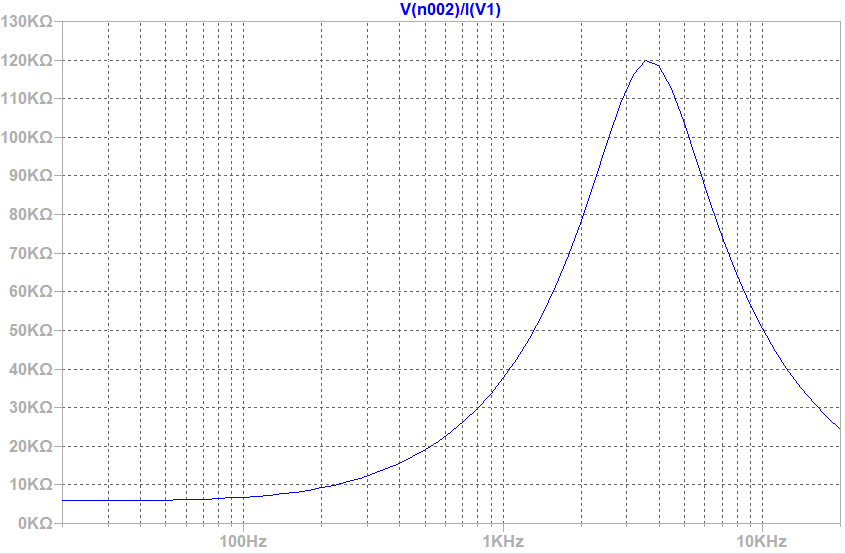
When the guitar is plugged into an amplifier, its output impedance behaves exactly like R1 in the voltage divider formula. If we want to transmit the instrument’s signal to the amplifier without losing treble or dynamics, the amplifier’s input impedance — equivalent to R2 — must be high enough to preserve signal integrity. This is why most amplifiers and effect pedals have an input impedance greater than 1 MΩ (1000 kΩ). In this way, the signal is only minimally attenuated and all frequencies are preserved.
3. Case study of a fuzz
But what about our favorite fuzz pedals? If we look at the typical input impedance of a vintage fuzz such as a Fuzz Face or a Tone Bender MK1.5, we quickly notice that it is not very high at all. It ranges from just a few kilo-ohms to a few tens of kilo-ohms — far below what we would normally expect.
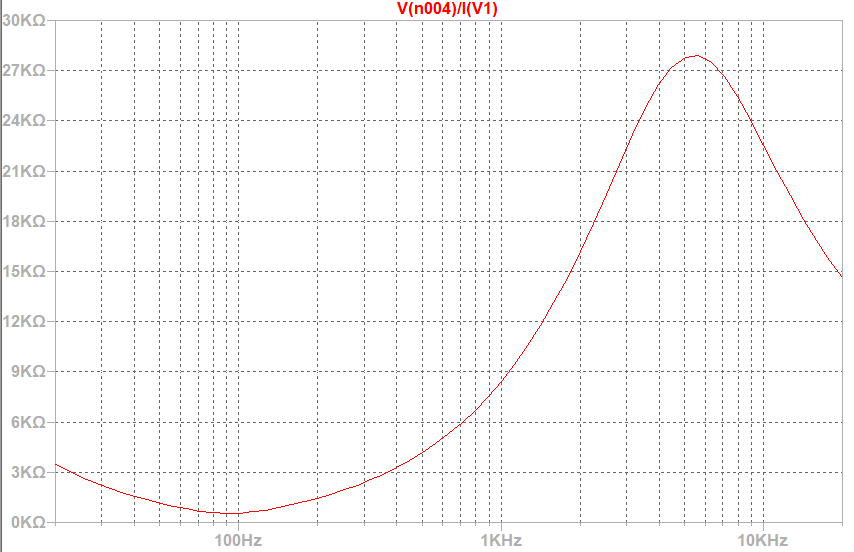
It is precisely because of this low input impedance that fuzz pedals interact so strongly with the guitar. When you clean up using the guitar’s volume control, you are not simply reducing the signal level going into the fuzz. You are also changing the impedance ratio between the guitar’s output and the fuzz’s input, which results in a completely different character.
This direct connection and impedance interplay between the pickup, the volume potentiometer, and the fuzz circuit is what gives the sound its organic quality. It allows you to move from a bright, present crunch with the volume rolled back to a thick, massive fuzz when the knob is wide open.
4. Buffer's puzzle
Some pedals include a built-in buffer, such as many models from Ibanez, Maxon, or Boss. A buffer is a small circuit designed to decouple what comes before the pedal from what comes after it in order to preserve the signal. It has a very high input impedance — like an amplifier — so it can adapt to virtually any source, and a very low output impedance, so its behavior does not depend on what follows it. On paper, this is extremely practical and ensures optimal signal quality.
Unfortunately, this operation completely breaks the interaction we have just described. Lowering the guitar’s volume no longer changes the impedance seen by the fuzz, because the buffer sits between them. As a result, you lose that beloved hairy clean-up response.
There is no real miracle solution to this issue other than placing your fuzz first in the signal chain. True bypass pedals can be placed before the fuzz without issue, but pedals with an always-active buffer must be placed after it. Even then, activating pedals placed before the fuzz will drastically alter its character.
I hope this technical article has helped you better understand why a fuzz should be placed directly after your guitar in a pedalboard. The guitar’s output impedance and the fuzz’s input impedance are inseparable from the sound you obtain and from that expressive clean-up capability. Even a single buffer inserted between the two will break this interaction.
Of course, not everyone wants to sacrifice pedalboard layout just for this reason. A modern alternative is to use a fuzz that intelligently integrates a properly designed buffer from the outset, preserving the character of the circuit while making it more versatile in real-world setups. This is precisely the case with the Distorter, which was designed from the start to address this issue and can therefore be placed anywhere in the signal chain — even after your reverbs.
Related posts
-
 Understanding saturation effects
Saturation effects are many : distortion, fuzz, overdrive, preamps... What should you look for on the market today ?Read more
Understanding saturation effects
Saturation effects are many : distortion, fuzz, overdrive, preamps... What should you look for on the market today ?Read more -
 The wonderful world of fuzz
Are you often left scratching your head when talking about fuzz ? Read our guides and understand the main differences...Read more
The wonderful world of fuzz
Are you often left scratching your head when talking about fuzz ? Read our guides and understand the main differences...Read more -
 The best fuzz pedal ever made : the Tonebender
The SolaSound Tonebender is the first fuzz pedal ever built in the United Kingdom, and it is the best fuzzbox ever...Read more
The best fuzz pedal ever made : the Tonebender
The SolaSound Tonebender is the first fuzz pedal ever built in the United Kingdom, and it is the best fuzzbox ever...Read more -
 The vacuum tube explained
No need to known electronics ! Let's have a look at how a vacuum tube operates, and learn the differences between...Read more
The vacuum tube explained
No need to known electronics ! Let's have a look at how a vacuum tube operates, and learn the differences between...Read more -
 Audio vacuum tubes for dummies
What are the most used vacuum tubes in audio and guitar amplifiers ? What does 12AX7, GZ34 or EL84 do to the sound ?...Read more
Audio vacuum tubes for dummies
What are the most used vacuum tubes in audio and guitar amplifiers ? What does 12AX7, GZ34 or EL84 do to the sound ?...Read more
Leave a comment