


A short analysis of the Klon Centaur, its associated myths and its alternatives
shopping_cart
0
Latest posts
-
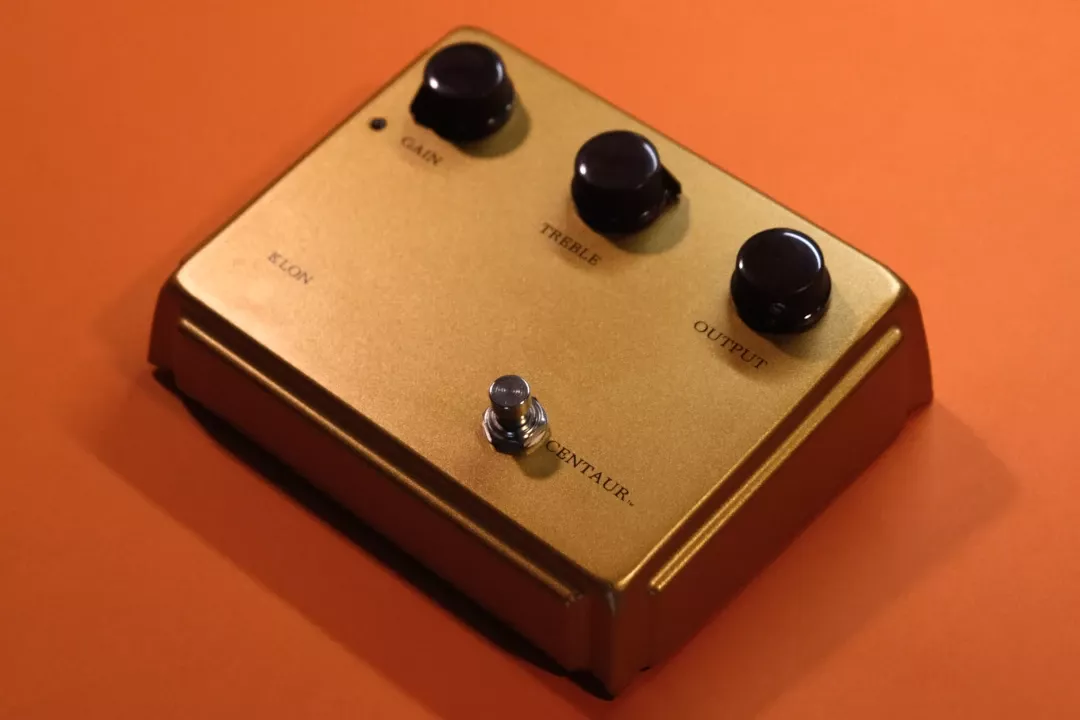 Why does the Klon work ?Read more
 -
 Why does the Tube Screamer sound bad ?Read more
The mythical Ibanez Tube Screamer is not free of issues ! Let's talk about why I dislike its sound so much.
-
 Master fuzz clean-up like a pro !Read more
Let's talk about volume clean-up, vintage fuzzes and buffer pedals, and how everything interacts together.
-
 Circuit Analysis : Electro Harmonix LPB1Read more
Let's dive deep into electronics and explore the Electro Harmonix LPB1 and Screaming bird at once !
-
 Master the art of reampingRead more
Let's talk about how to use a DI box and a reamp box and what they are doing under the hood.
-
 How to record an electric guitar : all about microphonesRead more
All you ever wanted to know about recording your electric guitar amplifier with microphones, but were afraid to ask !
-
 Guitar preamps: are they a scam?Read more
Understand what really is a guitar preamp pedal, its difference with a studio preamp and an overdrive pedal, and how...
-
 The art of stacking effects pedalsRead more
Discover how to master pedal stacking with overdrives, saturations, compressors, and time-based effects. Learn the...
-
 The ultimate power supply guideRead more
Let's explore what make a good power supply, how to choose one and how to read their labels to prevent frying up your...
-
 Flanger is the BEST modulation pedalRead more
Hot take : flanger is definitely the best modulation effect ever invented. I can have it replace a phaser, a chorus...
Blog categories
Search in blog
Why does the Klon work ?
If I tell you “boutique transparent overdrive”, there’s a good chance you’ll think of the Klon Centaur. It is the very embodiment of the boutique pedal: handmade in small quantities, the circuit covered in epoxy to prevent it from being copied, a circuit that had never been used before, and a real attention to detail. Today, I’d like to take a look at what makes the Klon Centaur what it is, its history, and the myths surrounding it.
1. Klon Centaur's history
In the early 80s, Bill Finnegan regularly played in Boston, with a Fender Telecaster and a Twin Reverb pushed as hard as possible. Unfortunately, he couldn’t always play at the volume needed to push his amplifier, and the Tube Screamer, which was already popular at the time, didn’t meet his needs — and you can’t really blame him!
Between 1990 and 1994, Bill therefore worked with friends from MIT on the creation of a new circuit that would compensate for the harmonic richness while preserving as much as possible the original sound of his instrument and the playing feel. In 1994, he started selling his pedal under the Klon LLC brand, and stopped production in 2008, considering that it was no longer possible to continue in this handmade form given the considerable demand for the pedal. He then built the Klon KTR, partially designed with Paul Cochrane, creator of the Timmy, which he started selling in 2014.
The Klon Centaur is probably the “boutique” pedal that has had the greatest impact on the sound of the electric guitar. Used by Jeff Beck, John Mayer, Matt Schofield, and hundreds of other guitarists, it has more than earned its status as a legendary overdrive. Every guitarist has probably played through a Klon or one of its variants at some point, and if you haven’t, I’d recommend giving one a try and seeing if you like it!
2. A half-horse under the hood
Let’s take a look at the Klon Centaur’s circuit and the myths surrounding it. As you can see below, it is quite a bit more complex than most overdrive circuits!
In the bottom right, we can see that the power supply uses a special chip to convert the incoming 9V into both -9V and +18V, effectively giving us a 27V range in which our signal can be amplified without unpleasant clipping. This “headroom” plays a major role in the Klon’s characteristic control over harmonics.
If we follow the signal path from left to right, the input first goes through a buffer that is always active. The pedal therefore uses buffered bypass rather than true bypass, which means it has to be powered at all times, but has the advantage of preserving the clarity and dynamics of the instrument.
The overdrive circuit is quite unusual: the audio signal follows three different paths. The first one, at the top, retains the low frequencies below 100Hz. The second one, at the bottom, bypasses the clipping stage and preserves the clean sound when the gain control is at minimum. The third amplifies the signal and clips it with a pair of 1N34A germanium diodes as the gain is increased. The three paths are then summed together before reaching a tone control that adjusts the treble level, and finally the master volume control.
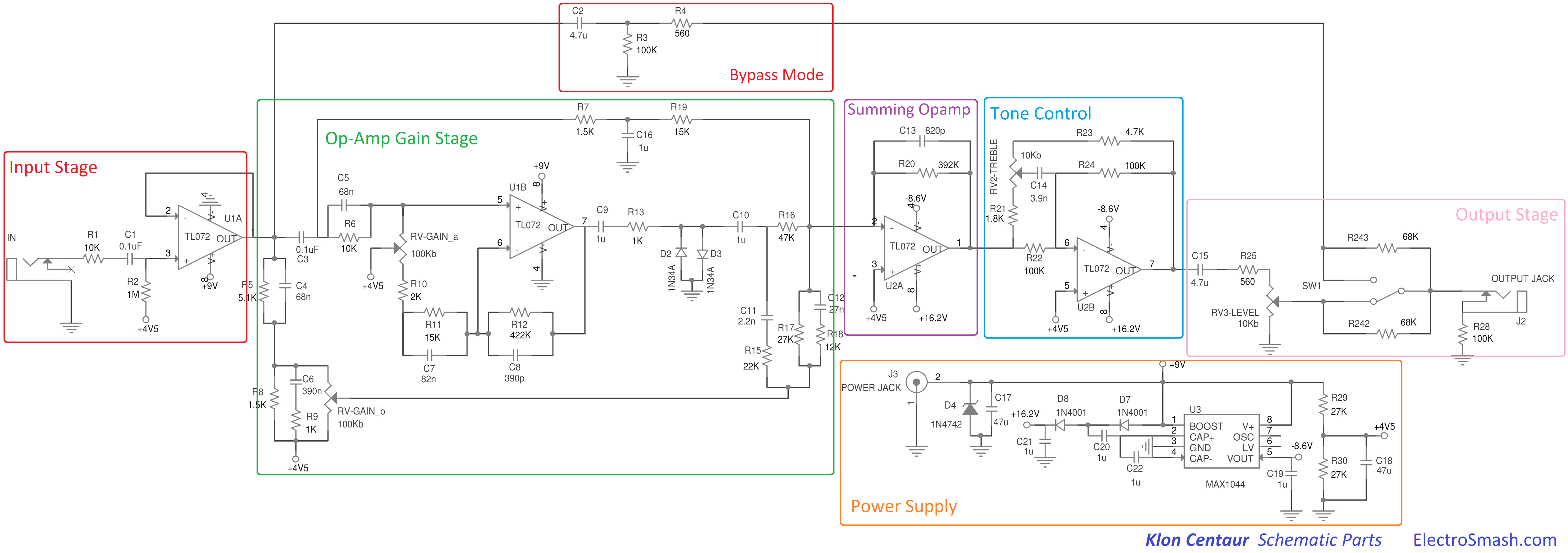
We are indeed not looking at the simplest circuit, I’ll give you that! Its dynamics and gain management make it a unique circuit, with the two sounds blended in parallel.
When it comes to the myths surrounding the Klon, it is often described as a transparent overdrive. However, the circuit has a frequency response with a hump in the mids, around 1kHz. To better understand what this term actually means, I already covered the subject in a previous article.
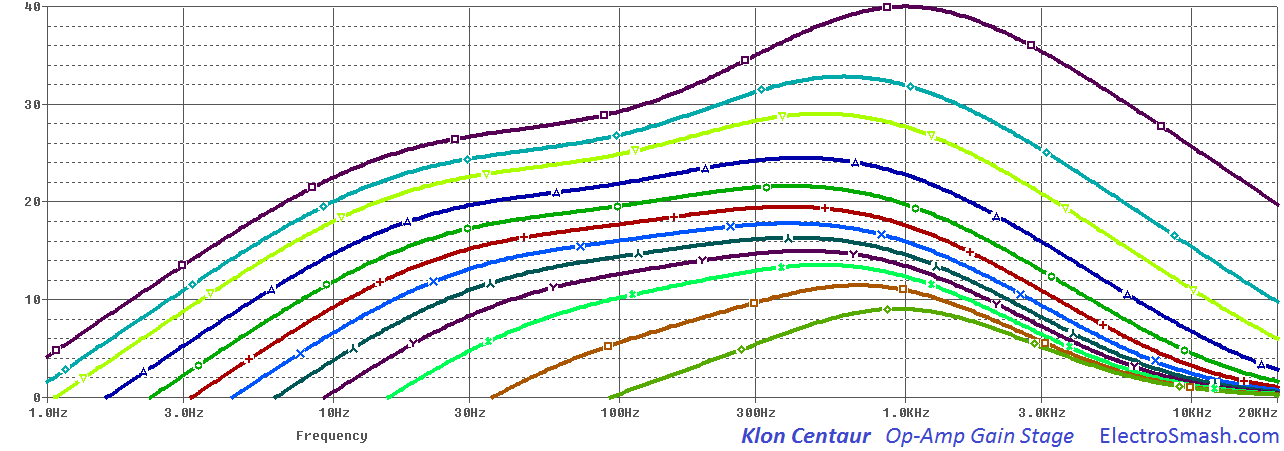
The second myth that comes up time and time again is related to the germanium diodes, the famous 1N34As, which are very difficult to find today. There is no doubt that these diodes have an influence on the behavior of the clipping stage, particularly because of their I-V characteristic. However, this does not mean that they are irreplaceable: it is possible to reproduce, at least approximately, a similar transfer curve using other components and therefore obtain similar behavior in the circuit. Even Bill, who was already using diodes from different manufacturers, had to modify the Klon KTR to adapt to different diodes in newer versions. The voicing — meaning the pedal’s overall EQ and its dynamic response — is actually the main factor responsible for the Klon’s “sound”.
You can often read that the Klon Centaur’s buffer is magical and has a unique sound. In reality, it is simply a basic op-amp buffer circuit. There is no sorcery involved, and many buffer pedals use this same approach. Perhaps the myth comes from the fact that some Boss and Ibanez pedals used a poorly designed JFET buffer that still absorbed some of the dynamics?
Likewise, there are no magical components inside the Klon: the op-amps are simply TL072s, which were relatively recent at the time. The rather unusual power supply circuit has now become standard among many manufacturers, and is known as a charge pump. It is worth noting that plugging the wrong power supply into a pedal that uses one can destroy it.
Finally, I have found no documented difference in the circuit or component values between silver and gold Klons. The differences would most likely come from component tolerances.
3. What about the sound?
In truth, the question is not really about the original Klon Centaur, whose price has become far too high for most musicians. Compared to a Tube Screamer, the Klon preserves the instrument’s dynamics and low end much better, but has a hump in the mids that will emphasize the snap of single-coil pickups and add some definition to humbuckers.
For a long time, I was disappointed by the way the gain control worked, with its mixture of clean and overdriven sounds. However, over time, and after having fun stacking my clone with other overdrives, I came to appreciate the dynamics this brings when other elements in the signal chain are also being pushed into saturation, whether pedals or the amplifier. It is ultimately quite close to the philosophy behind the Distorter, where the clean and saturated sounds have separate volume controls, although it is not based on the Klon.
Finally, I wouldn’t recommend the Klon for someone who plays exclusively through a clean amplifier, unless you are looking for a strong volume boost and want to push the amp to its limits, as Bill intended. To me, the Klon makes more sense for boosting an amplifier that is already on the edge of breakup, or even a metal amp in the same way you would use a Tube Screamer, or another light overdrive such as a Bluesbreaker-style pedal.
Finally, don’t forget to try the Klon Centaur at different points in your signal chain and play around with the gain settings. You will probably find another use for this pedal beyond the classic always-on, end-of-chain, gain-at-zero setup, which, incidentally, doesn’t use the pedal’s diodes at all.
4. The alternatives
If you’d like to keep your kidneys, buying an original is out of the question: they now easily sell for several thousand euros. The most obvious alternative is of course the Klon KTR, which is still in production.
If you’re looking for slightly cheaper copies, the Wampler Tumnus and J. Rockett Archer have already more than proven themselves.
Electro-Harmonix also makes the Soul Food, which is based on the same architecture, and MXR has the Sugar Drive. Finally, for the tightest budgets, the Mosky Golden Horse and Tone City Bad Horse will still get you reasonably close.
If you’re looking for a different sound from the original Klon, or simply more options, take a look at the Tumnus Deluxe, the Origin Effects Halcyon, the Keeley Mantis, or the J. Rockett Rockaway.
This article has now come to an end, which is probably for the best given its length! The Klon Centaur is a legendary overdrive for good reasons, and not merely a trophy to keep on a collector’s shelf. If you’ve never tried one, I really encourage you to do so, if only to get an idea of the sound and dynamics it brings. Finally, as always, I encourage you to experiment and try different positions in your pedalboard to find the place where it works best for your playing. Personally, I’ll stick with what the Distorter brings me as a very different alternative, but one that is closer to what I like — after all, that’s primarily why I build my own effects!
Related posts
-
 Different flavours of overdrive
Overdrive definitely is the queen of saturation effects. There are so many ofthem though, how can you be sure to...Read more
Different flavours of overdrive
Overdrive definitely is the queen of saturation effects. There are so many ofthem though, how can you be sure to...Read more -
 The truth about transparent overdrive
In this article, I talk about the concept of transparent overdrive, and why this designation became a marketing...Read more
The truth about transparent overdrive
In this article, I talk about the concept of transparent overdrive, and why this designation became a marketing...Read more -
 Understanding saturation effects
Saturation effects are many : distortion, fuzz, overdrive, preamps... What should you look for on the market today ?Read more
Understanding saturation effects
Saturation effects are many : distortion, fuzz, overdrive, preamps... What should you look for on the market today ?Read more -
 The wonderful world of fuzz
Are you often left scratching your head when talking about fuzz ? Read our guides and understand the main differences...Read more
The wonderful world of fuzz
Are you often left scratching your head when talking about fuzz ? Read our guides and understand the main differences...Read more -
 The tone of the RAT
The ProCo RAT is one of the most known distorsion pedal. Learn about its tone and history here !Read more
The tone of the RAT
The ProCo RAT is one of the most known distorsion pedal. Learn about its tone and history here !Read more
Leave a comment